Give First The Best Approach to Meaningful Connections and Sustainable Success
The Most Misunderstood Growth Strategy
We’ve been taught to optimize.
Optimize your funnel. Optimize your network. Optimize your time, capital and social capital.
And somewhere along the way, relationships quietly became transactions.
This guide is for founders, mentors, investors, and anyone seeking to build meaningful professional relationships and sustainable success. Understanding the Give First philosophy is crucial in today's fast-paced, transactional world, especially in startup and tech communities where trust and reputation are key.
We don’t intend it to happen. But it does. More often than we are willing to admit. You meet people thinking, “What’s the angle?” You assess conversations based on ROI. You help… as long as it’s efficient. Or, what's there in return?
The problem?
Transaction-first thinking caps upside. Adopting a non-transactional mindset can fundamentally change your professional reputation and network dynamics. You become known as the helpful person, not just another contact.
Brad Feld’s Give First philosophy isn’t soft. It isn’t naive. And it definitely isn’t charity.
It’s a long-term compounding strategy for building trust, influence and durable advantage, especially in startup ecosystems where reputation travels faster than capital. Leading with generosity creates a foundation of trust, making others more likely to support you later. Practicing Give First helps you build meaningful connections throughout your professional life. But this equally applies to one's personal life. The key to abundant relationships is to never keep score. "You did this. I did this." It is myopic to do so.
This guide breaks down why the Give First framework works, how to practice it without being exploited and why it’s becoming more, not less, important in an AI-saturated, low-trust future.
Foundation: What “Give First” Actually Means (And What It Doesn’t)
The Give First philosophy "encourages individuals to give their time, resources and expertise to others without expectation of immediate return."
The Core Principle
At its core, Give First means contributing time, energy, expertise, or social capital without expecting an immediate return.
Not never receiving value. Not being self-sacrificial. Not being passive.
It means you decouple giving from timing and control.
Brad Feld articulated this principle most clearly in Startup Communities and The Startup Community Way, based on over a decade of experience as:
- A founder
- A venture capitalist (Foundry Group)
- A mentor embedded in startup ecosystems globally
His principles have been developed and proven effective over a decade or more, resulting in insightful reflections that inspire continuous learning and impactful mentorship practices.
We believe so strongly in these principles that we modelled the Social Contract for the Future Ventures Community on them.
Give First ≠ Free Labour
But let’s be clear and precise.
| Give First Is | Give First Is Not |
|---|---|
| Long-term oriented | Naive altruism |
| Trust-building | People-pleasing |
| Ecosystem-positive | Boundary-less |
| Leader-driven | Title-driven |
| Non-transactional | Anti-self-interest |
| Give First rejects short-term reciprocity and self-interest. |
The expectation isn’t nothing ever comes back. The expectation is you don’t keep score.
The Transaction Trap (And Why It’s So Tempting)
Transaction thinking feels rational.
You’re busy. You’re scaling. You’ve been burned before.
So you start asking:
- “Is this worth my time?”
- “What do I get out of this?”
- “Is this person senior enough?”
- "Are they in a position of authority or influence?"
“The issue isn’t efficiency. The issue is you start filtering for upside instead of trust.”
To move beyond transactional thinking, consider practical tips like offering "Micro-Help". Spend just a few minutes giving feedback or sharing a helpful tool with someone facing a challenge.
The Hidden Cost of Transactional Networks
Transactional networks:
- Are brittle under stress
- Collapse when incentives change
- Discourage honest vulnerability
- Exclude early-stage talent that later becomes influential
Give First networks:
- Are resilient
- Compound over time
- Surface unexpected opportunities
- Create psychological safety
You don’t build optionality by optimizing too early. You build it by being useful before it’s obvious.
Mentorship Without Strings: The Highest-Leverage Expression of Give First
Brad Feld is explicit on this point:
“Mentorship only works when it’s given freely, without expectation.”
Developing strong mentorship skills is essential for personal and professional growth. The journey of becoming an extraordinary mentor involves adopting a giving mindset, continuously learning, and inspiring others. This process not only benefits mentees but also helps build vibrant, supportive communities.
Why Strings Kill Mentorship
The moment mentorship becomes conditional:
- The mentee self-censors
- Power dynamics distort honesty
- Learning slows
- Trust evaporates
Unconditional mentorship creates:
- Faster learning loops
- Deeper insight exchange
- Emotional safety
- Stronger long-term relationships
What Extraordinary Mentors Actually Do
Extraordinary mentors:
- Ask before advising
- Share pattern recognition, not prescriptions
- Make introductions without hovering
- Step back when no longer needed
They give perspective, not control. Becoming an extraordinary mentor starts with being an extraordinary mentee. So surround yourself with mentors and treat those relationships like work: seriously and unconditionally.
Give First as Positive Feedback Loops
Think of Give First as infrastructure, not behaviour.
When you give without expectation:
- Trust increases
- Information flows faster
- People take more risks
- Collaboration increases
- Outcomes improve for everyone
This is a network effect, not a moral stance.
The Compounding Model
| Time Horizon | Give First Outcome |
|---|---|
| Short term | No obvious payoff |
| Medium term | Reputation accrues |
| Long term | Asymmetric opportunity flow |
| Most people quit in the short term because the rewards are non-linear. |
"Seed and you shall sow and reap"
Leaders, Not Titles: Who Must Give First
Leadership isn’t hierarchy. Leadership is commitment to the long term.
Leaders who give first play a crucial role in shaping the startup economy, as their generosity and support help foster innovation, strengthen startup communities, and drive ecosystem growth.
Leaders Are Defined By:
- Staying when cycles turn
- Investing in newcomers
- Protecting community norms
- Giving when it’s inconvenient
If you’re a founder, CEO, or scaling operator, you are already a leader, whether you accept it or not.
Your behaviour sets cultural gravity.
The Impact of Power Dynamics
Power dynamics play a crucial role in the scale-up world. As Brad Feld highlights, the balance of power among mentors, investors, and founders can make or break a lasting startup community. The Give First philosophy urges moving beyond transactional mindsets: focusing on mentorship without strings attached rather than immediate returns.
When mentors or investors act transactionally, it creates an imbalance. Founders, especially early-stage ones, may feel pressured to perform or reciprocate prematurely, stifling honest communication and risk-taking. This slows growth for individuals and the ecosystem alike.
Investor Brad Feld highlights that mentorship, not just capital, is vital for a vibrant startup community. Mentors who help first enable founders to discover core values, develop entrepreneurial skills, and build meaningful, empathetic connections that strengthen the network.
Mentorship without strings turns isolated efforts into thriving, supportive environments. By giving without keeping score, mentors and investors nurture trust and collaboration, creating ripples that benefit individuals and whole communities as knowledge and opportunities flow freely.
For early-stage entrepreneurs, fair power dynamics are vital. Lacking established networks, these founders depend on the generosity and guidance of experienced mentors and investors. Embracing the Give First philosophy helps level the playing field, ensuring that the next generation of founders receives the support they need to succeed.
Ultimately, as Brad Feld notes, startup communities aren’t built on capital alone. They thrive when leaders give first, mentor selflessly, and build positive feedback loops that sustain growth and innovation. Recognizing and addressing power dynamics helps create stronger, more inclusive startup networks, benefiting companies and communities for years to come.
Practical Applications: How You Give First Without Burning Out
Give First does not mean:
- Unlimited availability
- Saying yes to everything
- Providing free consulting indefinitely
It means intentional generosity with boundaries. The following are practical tips to help you implement the Give First philosophy in real-world situations. Remember, intentional generosity can be such a gift. Not only does it support and uplift others, but it also brings unexpected rewards and fulfillment to the giver.
Tactical Ways to Give First
- Make high-quality introductions (and step away)
- Share lessons learned publicly
- Offer feedback, not deliverables
- Normalize helping early-stage founders
- Mentor for a season, not forever
These tactical ways to give first are drawn from real-life examples of effective mentorship and community building.
Boundary Framework
| Question | If "Yes" | If "No" |
|---|---|---|
| Is this aligned with my values? | Proceed | Decline |
| Can I help without resentment? | Proceed | Decline |
| Am I the right person? | Proceed | Refer |
Giving with resentment isn’t Give First. It’s deferred resentment.
Case Insight: Why Startup Ecosystems Succeed or Fail
Brad Feld’s research across ecosystems shows consistent patterns. Early-stage entrepreneurial activities, such as startup weekend events, play a crucial role in building strong startup communities. The first startup weekend events are especially significant, as they foster connections, mentorship, and the growth of local entrepreneurial ecosystems from the ground up. Local groups like the Montana Programmers Group further illustrate the importance of community engagement and mentorship, providing a platform for networking and support that helps nurture innovation and leadership within regional tech communities.
Thriving Ecosystems: Building a Vibrant Startup Community
- Have visible Give First leaders
- Welcome newcomers quickly
- Share institutional knowledge
- De-emphasize gatekeeping
Fragile Ecosystems:
- Optimize for deal flow
- Centralize power
- Reward extractive behaviour
- Over-index on status
The difference isn’t capital. It’s culture.
The Give First Matrix: Motivation vs Expectation
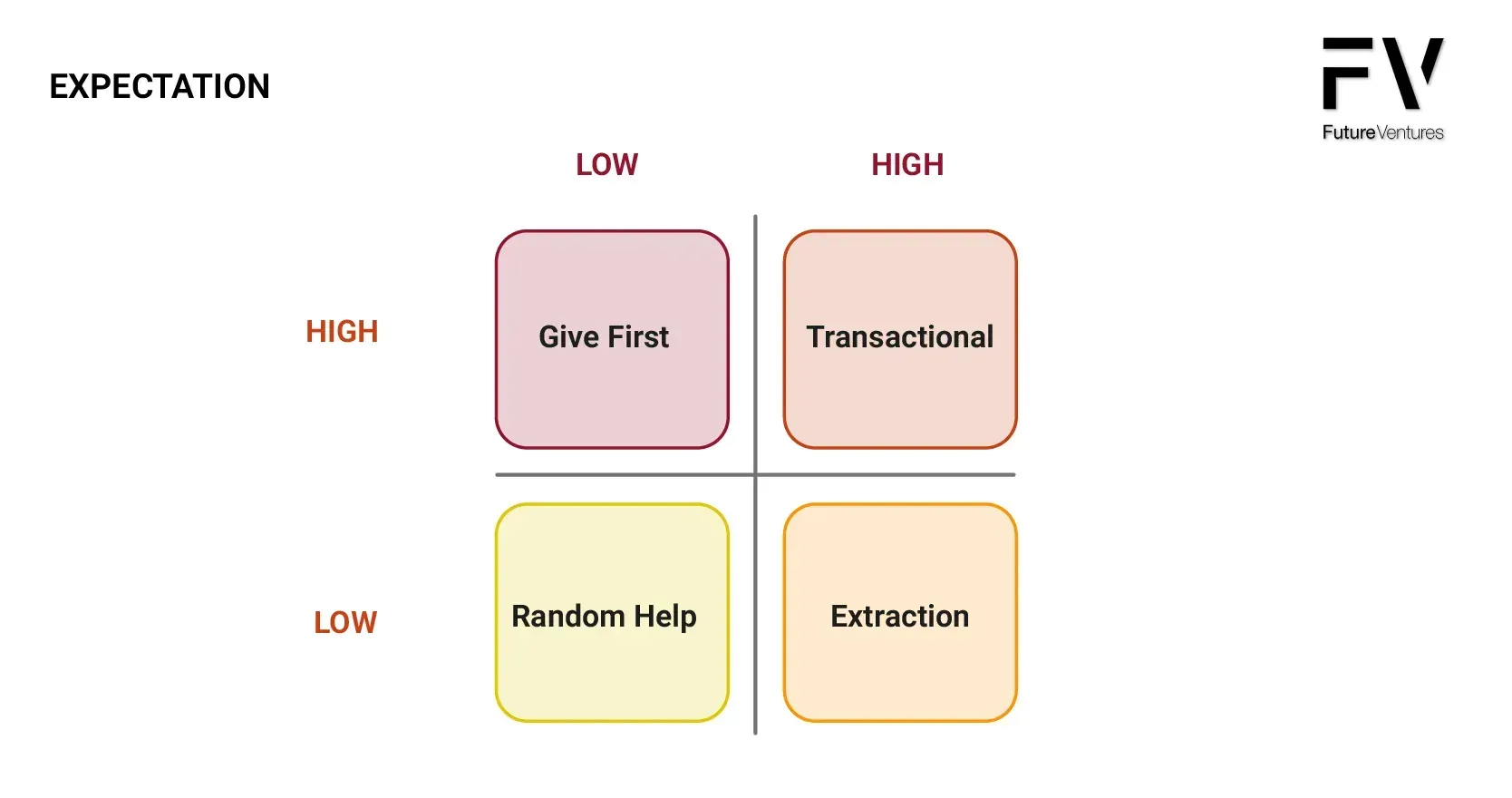
Give First lives in the high-motive, low-expectation quadrant. That’s where trust compounds.
Future Ventures' Lens: Why "Give First" Matters More in the AI Era
As AI:
- Lowers the cost of execution
- Commoditizes information
- Increases surface-level expertise
Trust becomes scarcer and far more valuable.
In a future where:
- Everyone can sound smart
- Advice is abundant
- Signals are noisy
Reputation, generosity, and relational depth become differentiators.
Give First is:
- Anti-gaming
- Anti-optimization
- Anti-shortcut
Which is exactly why it works.
The Strategic Payoff (Without Romanticizing It)
Let’s be clear. Give First:
- Does not guarantee success
- Does not replace competence
- Does not eliminate competition
But it dramatically increases surface area for opportunity.
It turns your network into:
- An early-warning system
- A talent radar
- A credibility amplifier
By embracing Give First, you empower individuals and communities by fostering trust, generosity, and authentic connections. And most importantly, it allows you to build influence without manipulation. Many successful venture deals result from the trust and relationships built through the Give First philosophy.
Actionable Takeaways
If you do nothing else, do this:
- Remove “What’s in it for me?” from first conversations
- Mentor without attachment to outcome
- Make introductions freely. And exit. No tit for tat.
- Protect your boundaries without guilt
- Play a long game in a short-term world
Many in the startup and scale-up communities are thankful that Brad brought these actionable principles and the Give First philosophy, which have inspired and transformed countless founders and mentors.
Final Thoughts: The Real Competitive Advantage
In a market obsessed with leverage, Give First looks inefficient.
It isn’t.
It’s an anti-fragile strategy disguised as generosity.
Brad Feld’s authentic, principled approach serves as a model for mentorship and leadership rooted in integrity and consistent values.
Brad's philosophy and approach have transformed startup communities and inspired countless others.
And in ecosystems where trust compounds faster than capital, the people who give first don’t finish last. They finish inevitably.
Related Insights and Thought Leadership to Explore